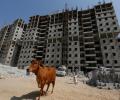
Experts say that the lockdown and its aftermath will further quicken the consolidation in the real estate sector, which has been taking place since 2012, with more small players going out of the business and bigger, branded players dominating the market.

Companies from Unilever to Proctor & Gamble, Nestl, Coca-Cola and PepsiCo have all alluded to lockdown challenges in India and the globe as well as the impact it will have on April-June as well as full-year numbers.

Retailers are also demanding that home delivery across all forms of retail should be allowed to ensure a level playing field.

'High-value homes are designed and built on slum lands and slums are given residue. They do not have access to free air and live in close proximity of others.'

Data from market research agency Nielsen shows that 152 new players entered the hygiene market in March as the lockdown was implemented to contain the spread of the coronavirus disease. The trend is expected to continue, the agency says, as hygiene and health emerge as key themes.
While FMCG companies were not barred from carrying out their operations during the 21-day lockdown, since most manufacture staples and essential products, capacity utilisation remained poor, owing to the restricted movement of raw materials, finished goods, and labour.

'Clearly, the next few months will be very challenging for industry.' 'We are clearly in a phase where recovery is a dream.'

Top companies reported that despite most of them making staples and essential products, movement of raw material, goods and labour remained restricted, impacting sales.
CREDAI-MCHI, a body of developers in Mumbai, has pegged the drop in sales booking at around 80 per cent in the February-March period this year. This is the second highest fall in residential sales in the past five years, after Q1, 2017, when the decline, due to the note ban, was 37 per cent.

Overcrowding, unsanitary conditions in Asia's largest slum pose big challenges to containment.

News viewership was the biggest gainer during the first full week of lockdown, growing 298 per cent versus the pre-COVID period between January 11 and 31. Ramayana, whose rerun has begun on Doordarshan, was the top-rated show on Saturday and Sunday.

Cancellation of at least Rs 3,000-crore worth of business has happened in the past few weeks.

The analyst said since servicing of principal and interest on loans will beome challenging for mall operatos in the next couple of months.

Retailers and multiplex operators want mall owners to either forgo rent for the period of the shutdown or lower rent in the event the mall is open but footfalls are low.

Employees asked to work from home... cancelled travel plans... curtailed meetings... Caution and precaution dominate Corporate India's response to Covid-19.

Weak demand from the poultry sector has resulted in a sharp decline in feed prices too, with both soybean and maize prices falling by nearly 25 per cent in the past two months. The poultry market consumes around half of soybean and maize production in India.

'There is a clear business impact. People are avoiding crowded places and gatherings across cities. This is hitting business, both at traditional and modern trade outlets, during the Holi season, which kicked off from Saturday,' says Praveen Khandelwal, general secretary, Confederation of All India Traders (CAIT).

RIL's stake in Network18 would reduce to 64 per cent, from 75%, following the merger
The first to see price hikes will be soaps. In the past six months, domestic palm oil prices have increased by 46 per cent. Palm oil is a key input going into soaps.

Experts feel that mall owners anticipate an increase in costs to the tune of 15-20 per cent annually, prompting a mixed response to the '24 hours' initiative. A mall owner said while the policy is good in spirit, implementing it would be a challenge as night shopping or eating out wasn't a habit in Mumbai yet.
 © 2025 Rediff.com - Investor Information - Advertise with us - Disclaimer - Privacy Policy - Sitemap - Feedback - About us - Terms of use - Grievances